
The Weight of the Jersey
He’s a junior in high school. A strong athlete. A baseball player with talent, discipline, and a reputation for always showing up ready to compete. From the outside, people see a kid who has it all together.
But during one of our sessions, he shared something that stopped me in my tracks.
He said the pressure he feels to earn a baseball scholarship while also keeping his grades up is overwhelming and causes him so much anxiety. Practices, games, workouts, homework, expectations from coaches, parents, and even himself. It all adds up.
Then he quietly said something that many people wouldn’t expect from a student athlete.
"Sometimes I just want to disappear."
Moments like this remind me why the work we do with students matters so much.
Hearing something like this can take you to immediate assumptions and judgments, but pausing to listen and not trying to respond will be important.
We often want to respond by trying to pump them with positive affirmations or remind them of all the great things they do or have, but POAC has a better tactic. Pausing and just listening provides an opportunity for them to discuss what they are truly feeling without judgment and without someone trying to “fix” them.
Student athletes aren’t given many of these opportunities and when we see this play out, it is important to allow them to communicate without fear. If we were honest, aren't there times where all of us just want to disappear. As a former principal, I often snuck away to a private restroom where I could take a deep breath and remind myself that I couldn’t solve every problem. Kids need to be taught that this is healthy.
According to the NFHS (National Federation of State High School Association) nearly 6 out of 10 student athletes report moderate to severe stress. Student athletes often carry a unique weight. They are told to be strong, tough, and mentally resilient. They are expected to perform in the classroom and on the field which causes so much anxiety.
We discuss anxiety as fear of the future. When you look at it through that lens it is easier to get to the root of what is happening. Discussing what is in our control and what is not in our control is something that helps students learn that stressing over something out of our control is a loss of power and staying centered on what they do have control over is a step in the right direction.
What people don’t always see in student athletes is the fear of letting others down, the constant comparison, and the belief that their future depends on their performance. When students have spaces where they can speak honestly about what they are feeling, without judgment, it can change everything.
At POAC, one of the things we teach students is that their value is never limited to a grade, a scholarship, or a scoreboard. Their worth is far bigger than that. Because behind the jersey is still a young person trying to figure out life, pressure, identity, and who they are becoming.
And sometimes, what they need most is not another practice or another expectation.
Sometimes they just need someone to listen.
After sharing his story, he admitted he was looking forward to a weekend off. Some time to catch up on school and simply breathe away from the field. You could feel the relief just by talking it through.
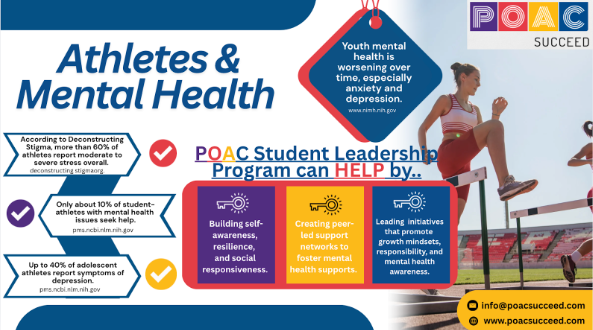
A female track athlete jumps over a hurdle with text highlighting mental health statistics for student athletes and how the POAC Student Leadership Program supports them.
It was a powerful reminder that sometimes the most meaningful support we can offer is to truly listen. When we pair that with encouraging healthy habits like rest, balance, and stepping away from screens, we help remind teens that their mental health matters just as much as their performance.
Deconstructing Stigma, an initiative launched in 2016 by McLean Hospital, is a global mental health awareness initiative focused on expanding public understanding of mental health and eliminating the stigma associated with it.
Please visit their website https://deconstructingstigma.org/get-support for more information and lots of resources
MORE INSPIRING READS


About the Author
Dr. Tracy Platt President of Educational Strategies, POAC Succeed
Dr. Tracy Platt is an experienced educator and leader who has spent more than 25 years supporting students, staff, and school communities. Her work focuses on trauma awareness, student behavior, and building systems that help people feel safe, valued, and connected. Tracy has served as a teacher, principal, and district leader, and she now guides POAC Succeed’s educational strategy with clarity and compassion. Her writing reflects her commitment to helping students understand themselves and feel seen in their school environment.

A powerful story of how Human‑Centered Classrooms help students feel seen, valued, and confident. This article shares how one student went from feeling like an outsider to becoming a leader who inspires younger students and strengthens school culture.